The Cure Rock and Roll Hall of Fame Families
| The Cure | |
|---|---|
 The Cure performing in Baronial 2007; from left to right: Pearl Thompson, Jason Cooper, Robert Smith, and Simon Gallup | |
| Groundwork information | |
| Origin | Crawley, Due west Sussex, England |
| Genres |
|
| Years agile | 1978–nowadays |
| Labels |
|
| Associated acts |
|
| Website | www |
| Members |
|
| Past members |
|
The Cure are an English rock ring formed in 1978 in Crawley, Westward Sussex.[1] [ii] [three] Throughout numerous lineup changes since the band's formation, guitarist, lead singer, and songwriter Robert Smith has remained the simply constant member. The ring's debut album was 3 Imaginary Boys (1979) and this, along with several early on singles, placed the band in the post-punk and new moving ridge movements that had sprung up in the United kingdom. Beginning with their 2nd album, Seventeen Seconds (1980), the band adopted a new, increasingly dark and tormented style, which, together with Smith's phase look, had a strong influence on the emerging genre of gothic rock likewise as the subculture that eventually formed around the genre.
Post-obit the release of their quaternary album Pornography in 1982, the band's future was uncertain. Smith was keen to move by the gloomy reputation his band had acquired, introducing a greater pop sensibility into the band'due south music. Songs such as "Allow'due south Get to Bed" (1982), "The Dearest Cats" (1983), "Inbetween Days" (1985), "Shut To Me" (1985), "Just Similar Heaven" (1987), "Lovesong" (1989), and "Friday I'm in Love" (1992) aided the ring in receiving commercial popularity. The ring have released 13 studio albums, two EPs, over thirty singles, and have sold over xxx 1000000 albums worldwide.
The Cure were inducted into the Stone and Roll Hall of Fame in 2019.[4] [v]
History [edit]
1973–1979: Germination and early years [edit]
The founding members of the Cure were school friends at Notre Dame Middle Schoolhouse in Crawley, Westward Sussex.[half-dozen] They beginning performed in public at an stop-of-year show in Apr 1973 every bit members of a one-off school-band chosen Obelisk.[7] That ring consisted of Robert Smith on pianoforte, Michael "Mick" Dempsey on guitar, Laurence "Lol" Tolhurst on percussion, Marc Ceccagno on lead guitar and Alan Hill on bass guitar.[7] In January 1976, while at St Wilfrid'south Comprehensive School, Ceccagno formed a five-piece rock ring with Smith on guitar and Dempsey on bass, along with ii other school friends.[8] They called themselves Malice, and rehearsed David Bowie, Jimi Hendrix and Alex Harvey songs in a local church building-hall.[9] By late April 1976 Ceccagno and the other two schoolhouse-friends had left, and Tolhurst (drums), Martin Creasy (vocals), and Porl Thompson (guitar) had joined the band.[10] This lineup played all iii of Malice's only documented live-shows during December 1976. In Jan 1977, post-obit Martin Creasy'south departure, and increasingly influenced by the emergence of punk rock, Malice'due south remaining members became known as Easy Cure – afterwards a song written past Tolhurst.[11]
After winning a talent competition, Easy Cure signed a recording contract with German tape characterization Ariola-Hansa on 18 May 1977.[8] In September 1977, Peter O'Toole (no relation to the actor), who had been the group's vocalist for several months, left the group to live on a kibbutz in Israel. Both Malice and Easy Cure auditioned several vocalists that month earlier Smith assumed the office.[12] The new iv-piece of Dempsey, Smith, Thompson, and Tolhurst recorded their start studio demo sessions every bit Easy Cure for Hansa at SAV Studios in London between Oct and November 1977.[13] None were ever released.[xiv]
The ring continued to perform regularly around Crawley (including The Rocket, St Edward'south, and Queen'southward Foursquare in detail) throughout 1977 and 1978. On 19 February 1978 they were joined at The Rocket for the first time by a support ring from Horley called Lockjaw, featuring bassist Simon Gallup.[fifteen] Hansa, dissatisfied with the group's demos, did non wish to release "Killing an Arab". The label suggested that the band attempt comprehend versions instead. They refused, and by March 1978 Easy Cure's contract with the label had been dissolved.[16] Smith afterwards recalled, "We were very immature. They only thought they could plough us into a teen group. They actually wanted us to do cover versions and we always refused."[14]
On 22 April 1978 Easy Cure played their last gig at the Montefiore Establish Hall (in the Three Bridges neighbourhood of Crawley)[17] before guitarist Porl Thompson was dropped from the lineup because his lead-guitar way was at odds with Smith's growing preference for minimalist songwriting.[18] Smith soon renamed the remaining trio "The Cure".[19] Afterwards that month the band recorded their first sessions equally a trio at Anecdote Studios in Sussex, producing a demo tape for distribution to a dozen major record-labels.[20] The demo institute its way to Polydor Records scout Chris Parry, who signed the Cure to his newly-formed Fiction characterization—distributed by Polydor—in September 1978.[21] The Cure released their debut single "Killing an Arab" in Dec 1978 on the Small Wonder characterization as a stopgap until Fiction finalised distribution arrangements with Polydor. "Killing an Arab" garnered both acclamation and controversy: while the single's provocative championship led to accusations of racism, the vocal is actually based on French existentialist Albert Camus's novel The Stranger.[22] The band placed a sticker label that denied the racist connotations on the single'southward 1979 reissue on Fiction. An early on NME article on the band wrote that the Cure "are similar a breath of fresh suburban air on the uppercase'due south smog-ridden pub-and-club circuit", and noted: "With a John Peel session and more than all-encompassing London gigging on their firsthand agenda, it remains to exist seen whether the Cure can retain their refreshing joie de vivre."[23]
The Cure released their debut anthology 3 Imaginary Boys in May 1979. Because of the band'due south inexperience in the studio, Parry and engineer Mike Hedges took command of the recording.[24] The band, particularly Smith, were unhappy with the anthology; in a 1987 interview, he admitted: "a lot of it was very superficial – I didn't even like it at the fourth dimension. There were criticisms made that information technology was very lightweight, and I thought they were justified. Even when we'd made it, I wanted to practice something that I thought had more than substance to it."[25] The band's second single, "Boys Don't Cry", was released in June. The Cure then embarked as the back up band for Siouxsie and the Banshees' Join Hands promotional tour of England, Northern Ireland, Scotland and Wales between August and October. The tour saw Smith pull double-duty each night past performing with the Cure and as the guitarist with the Banshees when John McKay quit the group in Aberdeen.[26] That musical feel had a strong impact on him: "On phase that first night with the Banshees, I was blown away by how powerful I felt playing that kind of music. It was then different to what nosotros were doing with the Cure. Before that, I'd wanted united states to be like the Buzzcocks or Elvis Costello; the punk Beatles. Being a Banshee really changed my attitude to what I was doing."[27]
The Cure'due south 3rd single, "Jumping Someone Else's Train", was released in early October 1979. Soon afterwards, Dempsey was dropped from the band considering of his cold reception to cloth Smith had written for the upcoming album.[28] Dempsey joined the Assembly, while Simon Gallup (bass) and Matthieu Hartley (keyboards) from the Magspies joined the Cure. The Associates toured equally support ring for the Cure and the Passions on the Future Pastimes Tour of England between November and Dec—all iii bands were on the Fiction Records roster—with the new Cure line-up already performing a number of new songs for the projected 2d anthology.[29] Meanwhile, a spin-off band comprising Smith, Tolhurst, Dempsey, Gallup, Hartley, and Thompson, with backing vocals from contrasted family and friends and lead vocals provided by their local postman Frankie Bell, released a 7-inch single in December under the name of Cult Hero.[xxx]
1980–1982: Early gothic phase [edit]
Due to the ring's lack of creative control on the first album, Smith exerted a greater influence on the recording of the Cure's 2nd album Seventeen Seconds, which he co-produced with Mike Hedges.[31] The album was released in 1980 and reached number twenty on the UK charts. A single from the album, "A Forest", became the ring's first UK hitting single, reaching number 31 on the singles chart.[32] The album was a departure from the Cure'southward audio upward to that point, with Hedges describing it equally "morose, atmospheric, very different to Three Imaginary Boys."[33] In its review of Seventeen Seconds the NME said, "For a grouping as immature as the Cure, it seems astonishing that they take covered so much territory in such a brief fourth dimension."[34] At the aforementioned fourth dimension, Smith was pressed concerning the concept of an alleged "anti-image".[35] Smith told the press he was fed up with the anti-image association that some considered to be "elaborately disguising their plainness", stating, "We had to go away from that anti-image affair, which we didn't even create in the showtime identify. And information technology seemed like we were trying to be more than obscure. We simply didn't like the standard rock affair. The whole thing really got out of manus."[36] That same year Three Imaginary Boys was repackaged for the American market as Boys Don't Cry, with new artwork and a modified runway list. The Cure ready out on their start world tour to promote both releases. At the finish of the tour, Matthieu Hartley left the band. Hartley said, "I realised that the group was heading towards suicidal, sombre music—the sort of thing that didn't interest me at all."[37]
The band reconvened with Hedges to produce their third anthology, Faith (1981), which furthered the dour mood present on Seventeen Seconds.[38] The album peaked at number fourteen on the United kingdom of great britain and northern ireland charts.[32] Included with cassette copies of Faith was an instrumental soundtrack for Carnage Visors, an animated film shown in place of an opening act for the band's 1981 Picture Tour.[39] In belatedly 1981 the Cure released the non-album unmarried "Charlotte Sometimes". By this point, the sombre mood of the music had a profound consequence on the attitude of the ring and they were "stuck in a ghoulish oestrus". Sometimes Smith would be so captivated past the persona he projected onstage he would leave at the end in tears.[forty]
In 1982 the Cure recorded and released Pornography, the third and final album of an "oppressively dispirited" trio that cemented the Cure's stature as purveyors of the emerging gothic rock genre.[41] Smith has said that during the recording of Pornography he was "undergoing a lot of mental stress. Only it had nothing to practise with the group, it simply had to practice with what I was similar, my historic period and things. I recollect I got to my worst round about Pornography. Looking back and getting other people's opinions of what went on, I was a pretty monstrous sort of person at that time".[25] Gallup described the album by proverb, "Nihilism took over [...] We sang 'It doesn't matter if we all dice' and that is exactly what we thought at the time."[42] Parry was concerned that the album did non take a hit song for radio play and instructed Smith and producer Phil Thornalley to smoothen the track "The Hanging Garden" for release as a unmarried.[43] Despite the concerns almost the album's uncommercial sound, Pornography became the band's showtime UK Acme ten album, charting at number viii.[32]
The release of Pornography was followed by the Fourteen Explicit Moments tour, where the band finally dropped the anti-paradigm angle and first adopted their signature look of large, towering pilus and smeared lipstick on their faces.[44] The tour also saw a series of incidents that prompted Simon Gallup to leave the Cure at the bout'due south conclusion. Gallup and Smith did non talk to each other for eighteen months following his departure.[45] Smith rejoined Siouxsie and the Banshees equally their lead guitarist in November 1982.[46] He afterwards became a full-time member of the band, and was featured on the live video and album Nocturne. He and so recorded the album Hyæna with them, but left the group 2 weeks before its June 1984 release to concentrate on The Cure.[47]
1983–1988: Commercial success [edit]
With Gallup'south divergence from the Cure and Smith'southward work with Siouxsie and the Banshees, rumours spread that the Cure had broken up. In December 1982, Smith remarked to Melody Maker, "Practice the Cure actually be any more? I've been pondering that question myself [...] it has got to a betoken where I don't fancy working in that format again." He added, "Any happens, it won't be me, Laurence and Simon together any more. I know that."[48]
Parry was concerned at the state of his label's top band, and became convinced that the solution was for the Cure to reinvent its musical style. Parry managed to convince Smith and Tolhurst of the idea; Parry said, "It appealed to Robert because he wanted to destroy the Cure anyway."[49] With Tolhurst now playing keyboards instead of drums, the duo released the single "Allow's Go to Bed" in late 1982. While Smith wrote the single equally a throwaway, "stupid" popular song to the press,[50] it became a pocket-size hit in the Uk, reaching number 44 on the singles chart,[32] only entered the Elevation twenty in Australia and New Zealand. It was followed in 1983 past ii more successful songs: the synthesiser-based "The Walk" (number 12), and "The Love Cats", which became the band's first British Pinnacle 10 hit, reaching number seven.[32] [51] These singles and their B-sides were compiled on the Japanese Whispers compilation, which was released in December 1983.[52]

In 1984, the Cure released The Top, a mostly psychedelic album on which Smith played about of the instruments except the drums (played by Andy Anderson) and the saxophone (played past Porl Thompson). The album was a Top x hit in the United kingdom of great britain and northern ireland, and was their first studio anthology to break the Billboard 200 in the Usa, reaching number 180.[32] [53] Melody Maker praised the anthology as "psychedelia that can't be dated", while pondering, "I've yet to meet anyone who can tell me why the Cure are having hits now of all times."[54] The Cure and then embarked on their worldwide Top Tour with Thompson, Anderson and producer-turned-bassist Phil Thornalley on lath. Released in late 1984, the Cure'southward starting time live anthology, Concert consisted of performances from this tour. Near the tour'southward terminate, Anderson was fired for destroying a hotel room and was replaced past Boris Williams.[55] Thornalley also left because of the stress of touring.[56] However, the bassist slot was not vacant long, for a Cure roadie named Gary Biddles had brokered a reunion between Smith and former bassist Simon Gallup, who had been playing in the ring Fools Dance. Soon after reconciling, Smith asked Gallup to rejoin the band.[57] Smith was ecstatic almost Gallup's render and alleged to Melody Maker, "It's a grouping once again."[58]
In 1985, the new line-up of Smith, Tolhurst, Gallup, Thompson and Williams released The Head on the Door, an album that managed to demark together the optimistic and pessimistic aspects of the band'south music between which they had previously shifted.[59] The Head on the Door reached number vii in the UK and was the band's first entry into American Tiptop 75 at number 59,[32] [53] a success partly due to the international touch on of the LP's two singles, "In Between Days" and "Close to Me". Following the album and world tour, the band released the singles compilation Standing on a Beach in iii formats (each with a unlike track list and a specific proper name) in 1986. This compilation made the U.s. Top 50,[53] and saw the re-issue of 3 previous singles: "Boys Don't Cry" (in a new form), "Let's Get to Bed" and, later, "Charlotte Sometimes". This release was accompanied by a VHS and LaserDisc chosen Staring at the Sea, which featured videos for each runway on the compilation. The Cure toured to support the compilation and released a alive concert VHS of the testify, filmed in the s of France called The Cure in Orangish. During this time, the band became very pop in Europe (particularly in France, Deutschland and the Benelux countries) and increasingly popular in both the US and Canada.[60]
In 1987, the Cure released the musically eclectic double LP Kiss Me, Buss Me, Kiss Me, which reached number six in the United kingdom, the Tiptop 10 in several countries[61] and was the band'southward start entry into the US Top 40 at number 35 (where it was certified platinum),[32] [53] [62] reflecting the band's rising mainstream popularity. The album's tertiary single, "Just Like Heaven", was the band's most successful single to date in the The states, being their first to enter the Billboard Top 40.[53] The album produced three other hit-singles. After the anthology'due south release, the ring recruited the Psychedelic Furs keyboardist Roger O'Donnell and successfully toured equally a sextet but during the European leg of the tour, Lol Tolhurst's alcohol consumption began to interfere with his ability to perform.[63]
1989–1993: Disintegration and worldwide stardom [edit]
In 1989, the Cure released the anthology Disintegration, which was critically praised and became their highest charting album to engagement, entering at number three in the UK and featuring three Summit 30 singles in the Great britain and Germany: "Lullaby", "Lovesong" and "Pictures of You".[32] [64] Disintegration also reached number twelve on the Us charts.[53] The first single in the United states of america, "Fascination Street", reached number one on the American Modern Rock chart, just was chop-chop overshadowed when its 3rd US single, "Lovesong", reached number 2 on the American pop charts (the only Cure single to reach the US Peak 10).[53] Past 1992, Disintegration had sold over three one thousand thousand copies worldwide.[65]
During the Disintegration sessions, the ring gave Smith an ultimatum that either Tolhurst would have to leave the band or they would.[66] In Feb 1989, Tolhurst's exit was fabricated official and announced to the press;[67] this resulted in O'Donnell becoming a full-fledged member of the band and left Smith as the Cure's only remaining founding member. Smith attributed Tolhurst'due south dismissal to an inability to exert himself and issues with alcohol, final, "He was out of step with everything. It had just get detrimental to everything we'd practise."[68] Because Tolhurst was still on the payroll during the recording of Disintegration, he is credited in the anthology's liner notes as playing "other instrument" (sic) and is listed equally a co-writer of every song; notwithstanding, it has since been revealed that while Tolhurst had contributed to the song "Homesick",[69] his contributions to the rest of the album were minimal due to his alcoholism.[69] The Cure then embarked on a successful bout which saw the band playing stadiums in the United states. On 6 September 1989, the Cure performed "Just Like Heaven" at the 1989 MTV Video Music Awards at the Universal Amphitheatre in Los Angeles.[70]
In May 1990, O'Donnell quit and was replaced with the band's guitar technician, Perry Bamonte.[71] That November, the Cure released a drove of remixes called Mixed Upwardly. The one new vocal on the drove, "Never Enough", was released as a unmarried. In 1991, the Cure were awarded the Brit Honour for Best British Group.[72] That same year, Tolhurst filed a lawsuit against Smith and Fiction Records in 1991 over royalties payments and claimed that he and Smith jointly endemic the name "the Cure"; the verdict was handed out in September 1994 in favour of Smith.
In respite from the lawsuit, the band returned to the studio to tape their side by side anthology.[73] Wish (1992) reached number i in the United kingdom and number two in the US and yielded the international hits "High" and "Friday I'1000 in Dearest".[32] [53] The album was also nominated for the Grammy Award for Best Alternative Music Anthology in 1993.[74] In the fall of 1993, the band released ii live albums, Show and Paris, featuring recordings from concerts on their world Wish tour.[75] [76]
Between the release of Wish and the start of sessions for the Cure'southward next studio album, the band'southward line-up shifted again.[77] Thompson left the band to play with Robert Plant and Jimmy Page of Led Zeppelin,[78] [79] Bamonte took over as atomic number 82 guitarist,[79] and O'Donnell returned to play keyboards.[77] Boris Williams also left the band and was replaced past Jason Cooper (formerly of My Life Story).[79]
1994–1998: Transition [edit]
In 1994 the band equanimous the original song "Burn" for the soundtrack to the movie The Crow, which went to number 1 on the Billboard 200 album charts.[eighty]
The sessions for the new album began in 1994 with only Smith and Bamonte nowadays; the pair were later joined by Gallup (who was recovering from physical problems) and keyboardist O'Donnell, who had been asked to rejoin the band at the end of 1994.[81] Cooper as well participated in the recording of the album.[82]
Wild Mood Swings, finally released in 1996, was poorly received compared with previous albums and marked the stop of the ring's commercial superlative.[83] Early in 1996, the Cure played festivals in South America, followed by a world tour in support of the album. In 1997 the band released Galore, a compilation album containing all of the Cure's singles released between 1987 and 1997, as well as the new single "Wrong Number", which featured longtime David Bowie guitarist Reeves Gabrels.[84]
In 1998 the Cure contributed the song "More Than This" to the soundtrack for The X-Files film, every bit well as a cover of "World in My Optics" for the Depeche Mode tribute anthology For the Masses.[85]
1999–2005: The Trilogy and line-upwardly changes [edit]
With only one album left in their record contract and with commercial response to Wild Mood Swings and the Galore compilation lacklustre, Smith in one case once more considered that the end of the Cure might exist near and thus wanted to make an album that reflected the more than serious side of the band.[86] The Grammy-nominated anthology Bloodflowers was released in 2000 after beingness delayed since 1998.[87] According to Smith, the album was the tertiary of a trilogy along with Pornography and Disintegration.[88] The band also embarked on the nine-month Dream Bout, which included 20 dates in the United States.[89] In 2001, the Cure left Fiction and released their Greatest Hits album and DVD, which featured the music videos for a number of classic Cure songs.[90] The ring released The Cure: Trilogy every bit a double live album video, on two double layer DVD-9 discs, and subsequently on a unmarried Blu-ray disc. It documents The Trilogy Concerts, in which the iii albums, Pornography, Disintegration and Bloodflowers were played alive in their entirety one after the other each night, the songs existence played in the order in which they appeared on the albums. Trilogy was recorded on two consecutive nights, 11–12 Nov 2002, at the Tempodrom Loonshit in Berlin.

The Cure in concert in 2004. From left to correct: Robert Smith, Jason Cooper, and Simon Gallup
In 2003, the Cure signed with Geffen Records.[91] In 2004, they released a new four-disc boxed set on Fiction Records titled Join the Dots: B-Sides & Rarities, 1978–2001 (The Fiction Years). The album peaked at number 106 on the Billboard 200 albums chart.[53] The band released their twelfth album, The Cure, on Geffen in 2004. It made a meridian ten debut on both sides of the Atlantic in July 2004.[32] [53] To promote the album, the band headlined the Coachella Valley Music and Arts Festival that May. From 24 July to 29 August, the Cure headlined the Curiosa concert tour of North America, which was formatted every bit a travelling festival and also featured Interpol, The Rapture, Mogwai, Muse, and Thursday, among other groups.[92] While attendances were lower than expected, Curiosa was even so one of the more successful American summer festivals of 2004.[93] The aforementioned twelvemonth the band was honoured with an MTV Icon award in a tv set special presented by Marilyn Manson.[94] In May 2005, O'Donnell and Bamonte were fired from the band.[95] [96] O'Donnell claims Smith informed him he was reducing the ring to a three-piece. Previously O'Donnell said he had only found out most the ring's upcoming tour dates via a fan site and added, "It was sad to find out after almost twenty years the way I did, but then I should have expected no less or more."[97] The remaining members of the band—Smith, Gallup and Cooper—made several appearances as a trio[91] before Porl Thompson returned to the Cure'south lineup for their summer 2005 bout.[98] In July 2005, the ring performed a set at the Paris concert of the Live eight series of benefit concerts.[99]
2006–2015: 4:13 Dream and Reflections [edit]
The Cure began writing and recording cloth for their thirteenth album in 2006.[100] The Cure postponed their autumn 2007 N American 4Tour in August to keep working on the anthology, rescheduling the dates for spring 2008.[101] The group released four singles and an EP—"The Only 1", "Freakshow", "Sleep When I'g Dead", "The Perfect Boy" and Hypnagogic States respectively—on or nearly to the 13th of each month, in the months leading up to the anthology's release. Released in October 2008, iv:13 Dream was a commercial failure in the UK compared to their previous album releases, only staying in the charts 2 weeks and not peaking higher than number 33. In February 2009, the Cure received the 2009 Shockwaves NME Award for Godlike Genius.[102]
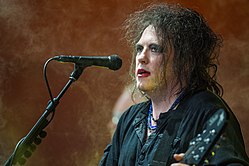
O'Donnell officially rejoined the Cure in 2011 earlier the band performed at the Brilliant Sydney festival in Commonwealth of australia.[91] This concert was the first in their Reflections concert serial, in which they performed their outset three albums in their entireties.[103] The band performed seven additional Reflections concerts in 2011, i in London, iii in New York Urban center and iii in Los Angeles.[104] On 27 September, the Cure was appear equally a nominee for 2012 induction into the Rock and Curl Hall of Fame.[105]
In NME's embrace article for March 2012, the Cure announced that they would exist headlining a series of summer music festivals across Europe, including the Leeds/Reading Festival.[106] [107] On one May, Porl Thompson, now known as Pearl Thompson, announced that they had left the Cure.[108] [109] On 26 May, the Cure embarked on a 19-date summer festival tour of Europe, commencing at the Pinkpop Festival, joined by former the Cure/COGASM collaborator Reeves Gabrels on guitar. On the same day, information technology was appear that Gabrels would be continuing in for the tour, but at that point was non a fully-fledged fellow member of the band.[110] [111] [112] Several weeks into the bout, the band invited Gabrels to become a member and he accepted.[113]
The Cure paid tribute to Paul McCartney on the anthology titled The Fine art of McCartney, which was released on 18 Nov 2014. The Cure covered the Beatles' vocal "Hello, Adieu" which featured invitee vocals and keyboards from Paul'southward son, James McCartney. A video of the ring and James performing the song was released on 9 September 2014 filmed at Brighton Electric Studio in Brighton.[114] Robert Smith also covered McCartney'southward "C Moon" on the album'southward bonus disc.[115] In the summer of 2015, the Disintegration track "Plainsong" was featured in a humorous moment in the movie Ant-Homo, only did not announced on the movie'south soundtrack.[116]
2017–present: 40th ceremony [edit]
In June 2018, The Cure headlined the 25th almanac Meltdown Festival in London.[117] Smith as well selected the festival'southward lineup, which included several of his personal favourite artists, including Nine Inch Nails, My Bloody Valentine, Deftones, Placebo, Manic Street Preachers, and Kristin Hersh, among others.[118] On 7 July 2018, Cure performed a 40th ceremony concert at Hyde Park as role of the British Summertime Time concert serial.[119] For Record Store Mean solar day 2018, the Cure released a remastered, deluxe edition of Mixed Upwards, forth with a sequel titled Torn Down featuring 16 new remixes all created by Robert Smith.[120]
In a 30 March 2019 interview with Rolling Stone, Smith commented on the band's adjacent album, saying, "For the first time in 20 years, we went into a studio—nosotros actually went into the studio where they (Queen) did 'Bohemian Rhapsody'. The songs are like 10 minutes, 12 minutes long. We recorded xix songs. So I have no idea what to do now... We'll stop it before we start in the summertime, and information technology'll be mixed through the summer. And then so release engagement, I don't know, October? Halloween! Come on!"[121] In an interview published on 5 July in NME, he noted that the band would be re-recording iii or four songs in August 2019 only that, "I experience intent on it being a 2019 release and would exist extremely bitter if information technology isn't."[122] However, the yr passed with no release.
In 2019, the Cure embarked on a 23-date summertime tour, consisting by and large of festival performances forth with four dates in Sydney, Commonwealth of australia. The terminal Sydney evidence on 30 May was live-streamed.[123] The band performed at the Austin City Limits Music Festival in October 2019.[124] After that same calendar month, the band issued 40 Live: CURÆTION-25 + Anniversary, a Blu-ray, DVD and CD box set featuring their Meltdown and Hyde Park performances from 2018 in their entireties.[125]
In interviews in June 2021, Smith referenced the recording of ii new Cure albums, saying "One of them's very, very doom and gloom and the other one isn't," and that the recordings take been completed, "I but take to decide who'due south going to mix them."[126] [127]
On 15 August 2021, bassist Simon Gallup posted on his social media that he was no longer in the Cure.[128] Still, no official statement about his difference was made past Smith or the band[129] and Gallup afterward deleted the mail service. On 14 October 2021, Gallup confirmed that he was still in the band.[130]
In March 2022, Smith revealed the title of the band's forthcoming anthology as Songs of a Lost Globe and said due to vinyl delays the earliest information technology will be released is September 2022, but that he would "rather it just come out" because he "can't stand up the anticipation". He likewise confirmed he had chosen the artwork and track listing, and mixing is "scheduled to begin in April".[131]
Musical style [edit]
The Cure are often identified with the gothic rock genre, and are viewed equally one of the form'due south definitive bands.[132] [133] [134] Nevertheless, the band has routinely rejected classification, particularly as a gothic rock band. Robert Smith said in 2006, "It's so pitiful when 'goth' is still tagged onto the proper noun the Cure", and added, "We're not categorisable. I suppose nosotros were post-punk when nosotros came out, simply in full information technology's impossible [...] I simply play Cure music, whatever that is."[135] While typically viewed as producers of dark and gloomy music, the Cure take also yielded a number of upbeat songs and been part of the new wave movement.[136] Spin has said "the Cure have always been an either/or sort of band: either [...] Robert Smith is wallowing in gothic sadness or he'southward licking sticky-sweet cotton-candy pop off his lipstick-stained fingers."[137]
The Cure'south primary musical traits have been listed every bit "ascendant, melodic bass lines; whiny, strangulated vocals; and a lyric obsession with existential, almost literary despair."[138] Most Cure songs first with Smith and Gallup writing the pulsate parts and bass lines. Both record demos at home so bring them into the studio for fine-tuning.[139] Smith said in 1992, "I think when people talk about the 'Cure sound', they mean songs based on six-string bass, audio-visual guitar and my vox, plus the string sound from the Solina."[139] On top of this foundation is laid "towering layers of guitars and synthesisers".[140] Keyboards have been a component of the band'south sound since Seventeen Seconds, and their importance increased with the instrument's extensive use on Disintegration.[141]
Music videos [edit]
The band's early music videos take been described equally "dreadful affairs" and have been maligned for their poor quality, specially by the band itself. Tolhurst said, "Those videos were unmitigated disasters; we weren't actors and our personalities weren't coming across."[142] The video for "Let'south Become to Bed" was their first collaboration with Tim Pope. The director added a playful chemical element to the band's videos; the managing director insisted in a 1987 Spin interview, "I think that side of them was e'er there, merely was never brought out."[25]
Pope would go on to straight the majority of the Cure's videos, which became synonymous with the ring, and expanded their audience during the 1980s.[143] Pope explained the appeal of working with the Cure by maxim, "the Cure is the ultimate band for a filmmaker to work with considering Robert Smith actually understands the camera. His songs are so cinematic. I hateful on 1 level there's this stupidity and sense of humour, correct, but below that there are all [Smith'south] psychological obsessions and claustrophobia."[144]
Legacy [edit]
The Cure were 1 of the first alternative bands to accept chart and commercial success in an era earlier alternative rock had broken into the mainstream. In 1992, NME declared the Cure had, during the 1980s, become "a goth hitting machine (19 to date), an international phenomenon and, yet, the most successful culling ring that ever shuffled disconsolately about the earth".[65] Equally a leading figure of gothic stone, NME made Smith the cover artist in their 2004 edition, Originals: Goth.[145]
Interpol lead vocaliser Paul Banks was quoted as maxim, "the Cure is the band that all of us in Interpol tin say influenced u.s.. When I was younger I listened to them a lot. Carlos likewise. Actually, he took a straight influence from this band on the manner he played the bass and the keys. To me, Robert Smith is too one of these examples: yous can't be Robert Smith if you're non Robert Smith. It's one of the bands with the deepest influence on Interpol, because nosotros all like them. They're legendary."[146] The Cure were also a formative influence on the Cracking Pumpkins. Frontman Billy Corgan has named the Cure as a chief influence,'[147] and drummer Mike Byrne described himself as a "huge Cure fan."[148]
The Stone and Whorl Hall of Fame chose the Cure for induction in its Class of 2019.[149] Although the Cure had been eligible for the Hall of Fame since 2004, they were just nominated once previously, in 2012.[150] The formal induction ceremony was held 29 March 2019 at the Barclays Eye in Brooklyn, New York. The members named by the Rock Hall for induction as part of the ring are Bamonte, Cooper, Dempsey, Gabrels, Gallup, O'Donnell, Smith, Thompson, Tolhurst and Williams.[150] Gabrels was initially non included in the consecration, but was added in February 2019.[151] At the Hall of Fame ceremony on 29 March 2019, the Cure were inducted past Trent Reznor and performed v tracks.[152]
The Cure have as well sold over thirty million albums worldwide.[153]
Awards and nominations [edit]
The Cure take been given at to the lowest degree half-dozen awards, including two Brit Awards (All-time British video for "Lullaby" in 1990, and Best British group in 1991), and a Viewer's Choice (Europe) MTV Video Music Award for "Fri I'm In Love" in 1992. Robert Smith was given an Ivor Novello Award for International Achievement in 2001.
The Brit Awards are the British Phonographic Industry'south (BPI) almanac pop music awards.[154] The Cure has received two awards from five nominations.
The European Festivals Awards were established in 2009. They are voted for by the public via the European Festival Awards website and receive hundreds of thousands of votes annually.[155] [156]
The Grammy Awards are awarded annually by The Recording Academy of the United States for outstanding achievements in the music industry. Often considered the highest music honour, the awards were established in 1958.[157]
The Ivor Novello Awards are awarded for songwriting and composing. The awards, named afterward the Cardiff built-in entertainer Ivor Novello, are presented annually in London by the British Academy of Songwriters, Composers and Authors (BASCA).[158]
The Juno Awards are presented annually to Canadian musical artists and bands to admit their creative and technical achievements in all aspects of music. New members of the Canadian Music Hall of Fame are also inducted as part of the awards ceremonies.[159]
The Los Premios MTV Latinoamérica is the Latin American version of the MTV Video Music Awards. It was established in 2002 to celebrate the pinnacle music videos of the year in Latin America and the earth.[160]
Lunas del Auditorio are sponsored by The National Auditorium in Mexico to honour the best alive shows in the country.[161]
The MTV Europe Music Awards were established in 1994 past MTV Networks Europe to gloat the most popular music videos in Europe.[162]
The MTV Video Music Awards were established in the end of the summer of 1984 by MTV to gloat the top music videos of the year.[163]
The MVPA Awards are annually presented past a Los Angeles-based music trade organization to honor the year's best music videos.
Music Television Awards
The NME Awards were created by the NME magazine and was first held in 1953.[164]
The Pollstar Concert Industry Awards is an annual laurels ceremony to honor artists and professionals in the concert industry. The Cure has been nominated 7 times.[165]
The Q Awards are the Great britain's almanac music awards run past the music magazine Q to accolade musical excellence. Winners are voted by readers of Q online, with others decided by a judging panel.[166]
Žebřík Music Awards
Discography [edit]
- Iii Imaginary Boys (1979)
- Seventeen Seconds (1980)
- Faith (1981)
- Pornography (1982)
- The Top (1984)
- The Head on the Door (1985)
- Kiss Me, Kiss Me, Kiss Me (1987)
- Disintegration (1989)
- Wish (1992)
- Wild Mood Swings (1996)
- Bloodflowers (2000)
- The Cure (2004)
- 4:13 Dream (2008)
Band members [edit]
- Robert Smith – lead vocals, guitars, 6-string bass guitar, keyboards (1978–present)
- Simon Gallup – bass guitar, keyboards (1979–1982, 1984–present)
- Roger O'Donnell – keyboards (1987–1990, 1995–2005, 2011–present)
- Jason Cooper – drums (1995–present)
- Reeves Gabrels – guitars, six-cord bass guitar (2012–present)
References [edit]
- ^ McPherson, Sam (17 April 2018). "The Cure working on new music as part of 40th anniversary". axs.com.
- ^ "The Cure: A Perfect Dream – A Bio of Robert Smith'southward Goth Ring". Rockarchive. 23 Baronial 2018.
- ^ Collins, Andrew (viii July 2019). "The Cure: Anniversary 1978–2018 Live in Hyde Park London – review". Radio Times.
- ^ "Class of 2019 inductees". Stone & Ringlet Hall of Fame . Retrieved xiii December 2018.
- ^ Doyle, Patrick (thirty March 2019). "The Cure'southward Robert Smith on Stone Hall Induction and 'F-cking Great' New Anthology". Rolling Rock.
- ^ Greg Metzer (21 May 2008). Rock Band Proper noun Origins. McFarland. p. sixty. ISBN9780786455317.
- ^ a b Jeff Apter (v November 2009). Never Plenty: The Story of The Cure. Charabanc Press. p. 26. ISBN9780857120243.
- ^ a b X Imaginary Years, by L. Barbarian, Steve Sutherland and Robert Smith (1988) Zomba Books ISBN 0-946391-87-4
- ^ The Cure, A History in Spiral Scratch Magazine by Rachel Doran, April 1992
- ^ Barbarian, Sutherland, Smith (1988)
- ^ Apter 2006, p. 36.
- ^ Apter 2006, p. 46.
- ^ A History of The Cure in Melody Maker Magazine by Steve Sutherland (1990)
- ^ a b Frost, Deborah (one Oct 1987). "Taking The Cure with Robert". Creem.
- ^ Barbaric, Sutherland, Smith (1988); and The Cure: A Visual Documentary, by Dave Thompson and Jo-Ann Greene (1988) Bus Press ISBN 0-7119-1387-0
- ^ Sutherland (1990) and Barbarian, Sutherland, Smith (1988)
- ^ Anomolie, Sureaud, Michaux, Ramage (1990–'92)
- ^ Sutherland (1990)
- ^ Apter 2006, pp. 56–57.
- ^ Apter 2006, p. 62.
- ^ Apter 2006, p. 68.
- ^ Hull, Robot A. (January 1982). "The Cure: ...Happily Ever After". Creem.
- ^ Thrills, Adrian (16 Dec 1978). "Ain't No Blues for the Summertime Cure". NME.
- ^ Apter 2006, p. 84.
- ^ a b c Sweeting, Adam (July 1987). "The Cure – Curiouser and Curiouser". Spin.
- ^ Apter 2006, pp. 105.
- ^ Paytress, Marking (2003). Siouxsie & the Banshees: The Authorised Biography. Sanctuary Publishing. p. 96.
- ^ Apter 2006, p. 106.
- ^ Apter 2006, p. 112.
- ^ Apter 2006, pp. 100–101.
- ^ Apter 2006, p. 114.
- ^ a b c d e f g h i j k Roberts, David, ed. (2006). British Striking Singles & Albums (19th ed.). Hitting Amusement. p. 130. ISBNane-904994-10-5.
- ^ Apter 2006, p. 117.
- ^ Kent, Nick (26 April 1980). "Why Science Can't Find Cure for Vagueness". NME.
- ^ Gosse, Van (21 April 1980). "The Cure Play It Pure". The Village Voice.
- ^ Morley, Paul (12 July 1980). "Days of Vino and Poses". NME.
- ^ Apter 2006, p. 126.
- ^ Apter 2006, p. 132.
- ^ Apter 2006, p. 136.
- ^ Apter 2006, p. 141.
- ^ Reynolds, Simon (2005). Rip It Upward and Get-go Again: Postpunk 1978–1984. Faber and Faber. p. 358. ISBN0-14-303672-half-dozen.
- ^ Apter 2006, p. 161.
- ^ Apter 2006, pp. 158–59.
- ^ Apter 2006, pp. 166–67.
- ^ Apter 2006, p. 171.
- ^ "Siouxsie And The Banshees: "Nosotros were losing our minds"". Uncut. 24 Oct 2014. Retrieved 18 September 2019.
- ^ Savage, Jon (26 July 2019). "Siouxsie and the Banshees: Our 1986 Interview". Spin . Retrieved eighteen September 2019.
- ^ Sutherland, Steve (18 Dec 1982). "The Incurables". Melody Maker.
- ^ Apter 2006, p. 174.
- ^ Apter 2006, p. 176.
- ^ "The Dear Cats – The Cure". Official Charts Visitor. 29 October 1983. Retrieved 27 Baronial 2018.
- ^ Truthful, Chris. "Japanese Whispers – The Cure | Songs, Reviews, Credits". AllMusic . Retrieved eighteen September 2019.
- ^ a b c d e f thou h i j "The Cure – Chart History | Billboard". Billboard . Retrieved 26 June 2013.
- ^ Sutherland, Steve (five May 1984). "Topsy-Turvy [The Top – review]". Melody Maker.
- ^ Apter 2006, p. 205.
- ^ Apter 2006, p. 207.
- ^ Apter 2006, p. 208.
- ^ Sutherland, Steve (17 Baronial 1985). "A Suitable Case for Treatment". Melody Maker.
- ^ Apter 2006, pp. 209–x.
- ^ Apter 2006, pp. 12–xiii.
- ^ "dutchcharts.nl – The Cure – Buss Me Osculation Me Osculation Me". dutchcharts.nl . Retrieved 26 June 2013.
- ^ "RIAA – Gold & Platinum Searchable Database – June 25, 2013". RIAA . Retrieved 26 June 2013.
- ^ Apter 2006, p. 229.
- ^ "Die ganze musik im net: Charts, neuersheinungen, Tickets, Genres, genresuche, genrelexion, kunstler-sache, musik-suche, rails-suche, ticket-suche – Musicline.de". Musicline.de. Archived from the original on 2 Apr 2009. Retrieved 26 June 2013.
- ^ a b Collins, Andrew (18 April 1992). "The Mansion Family". NME.
- ^ Apter 2006, p. 238.
- ^ Apter 2006, p. 240.
- ^ Brown, James (8 April 1989). "Ten Years in Lipstick and Powder". NME.
- ^ a b "Lol Tolhurst – Interview". world wide web.pennyblackmusic.co.uk.
- ^ Crampton, Luke (1999). Rock Stars Encyclopedia. p. 268.
- ^ "The Cure Cut Two, Ending 10-Year Run With Same Lineup". MTV News.
- ^ "Commodity: Slowly merely Surely, Hip Hop Is Gaining a South. The Orlando Sentry | AccessMyLibrary – Promoting Library Advocacy". AccessMyLibrary . Retrieved 26 June 2013.
- ^ Apter 2006, p. 255.
- ^ "The Cure Grammy nominations". GRAMMY.com. four June 2019. Retrieved 18 September 2019.
- ^ Raggett, Ned. "Show – The Cure | Songs, Reviews, Credits". AllMusic . Retrieved 18 September 2019.
- ^ Erlewine, Stephen Thomas. "Paris – The Cure | Songs, Reviews, Credits". AllMusic . Retrieved eighteen September 2019.
- ^ a b "The Cure | Biography & History". AllMusic.
- ^ "The Cure Finds a Remedy in Changes". Los Angeles Times. 5 June 1996.
- ^ a b c "The Cure ring members say good day". 29 May 2005 – via news.bbc.co.u.k..
- ^ "The Crow [Original Soundtrack]". Allmusic . Retrieved eleven July 2020.
- ^ Apter 2006, p. 270.
- ^ "The Cure". Hip Online. 13 January 2008. Retrieved 25 June 2019.
- ^ Apter 2006, p. 275.
- ^ "Reeves Gabrels Joins The Cure". Nashville Scene . Retrieved 14 December 2019.
- ^ "The Cure – EPK for The Masses Depeche Tribute (Robert Smith 1998)". YouTube. ten May 2017. Archived from the original on 16 November 2021. Retrieved 10 May 2017.
- ^ Apter 2006, pp. 281, 284.
- ^ Apter 2006, p. 284.
- ^ Hodgkinson, Will (30 May 2003). "Home Entertainment: Robert Smith | Music | The Guardian". The Guardian . Retrieved 26 June 2013.
- ^ "Cure Announce World Tour For Bloodflowers". MTV News . Retrieved 14 December 2019.
- ^ "Cure Bolsters 'Hits' With New Songs, Acoustic Disc". Billboard . Retrieved fourteen December 2019.
- ^ a b c "The Cure Official Biography". The Cure . Retrieved xiv December 2019.
- ^ "Cure Denote Festival Tour With Interpol, Rapture, Mogwai". MTV News . Retrieved fourteen December 2019.
- ^ Apter 2006, p. 295.
- ^ Weber, Tim (20 September 2004). "BBC News | Amusement | The Cure Accept the Icon Test". BBC News . Retrieved 26 June 2013.
- ^ "Update: 2 Members Get out The Cure". Billboard . Retrieved 17 Jan 2021.
- ^ "The Cure band members say goodbye". 29 May 2005. Retrieved 17 Jan 2021.
- ^ "Update: Two Members Exit The Cure | Billboard". Billboard . Retrieved 26 June 2013.
- ^ "Cure recruit former guitarist". NME. 21 June 2005. Retrieved 20 February 2020.
- ^ Flore, Raymond. "Alive viii vs. Alive Aid". EW.com . Retrieved 20 February 2020.
- ^ "The Cure Announce Render | The Cure | News | MTV United kingdom of great britain and northern ireland". MTV. 13 May 2008. Retrieved 26 June 2013.
- ^ Lindsay, Cam (24 August 2007). "The Cure Postpone Fall Tour • News • Exclaim.ca". Exclaim.ca . Retrieved 26 June 2013.
- ^ "Shockwaves NME Awards 2009: The Winners | News | nme.com". NME. 26 February 2009. Retrieved 26 June 2013.
- ^ Perpetua, Matthew (28 September 2011). "The Cure to Perform Their First Iii Albums". Rolling Stone . Retrieved 14 December 2019.
- ^ "The Cure to Perform Starting time Iii Albums Live at Majestic Albert Hall – Ticket Details | News | nme.com". NME. 27 September 2011. Retrieved 26 June 2013.
- ^ "The Cure, Guns n' Roses and Red Hot Chili Peppers Shortlisted for Rock and Roll Hall of Fame | News | nme.com". NME. 27 September 2011. Retrieved 26 June 2013.
- ^ "The Cure'due south Robert Smith: "We're Coming Full Circle past Headlining Reading and Leeds" | News | nme.com". NME. sixteen March 2012. Retrieved 26 June 2013.
- ^ "Chain of Flowers: Robert Interview in the New NME". Blogspot. xiii March 2012. Retrieved 26 June 2013.
- ^ "Chain Of Flowers: A note from Porl". Chain of Flowers. 1 May 2012.
- ^ "The Cure's Porl Thompson auctioning guitars, album artwork, leather corsets and more". Slicing Up Eyeballs. 1 May 2012. Retrieved fourteen December 2019.
- ^ "Video: The Cure Debuts Guitarist Reeves Gabrels, Digs Out Rarities at Pinkpop Festival". Slicing Up Eyeballs. 26 May 2012. Retrieved 26 June 2013.
- ^ "Chain of Flowers: The Cure at Pinkpop 2012". Chain of Flowers. 28 May 2013. Retrieved 26 June 2013.
- ^ "Concatenation of Flowers: Reeves Gabrels Joins The Cure for the Summer". Chain of Flowers. 26 May 2012. Retrieved 26 June 2013.
- ^ Mahoney, Lesley (26 June 2012). "Alumni Profile: Reeves Gabrels | Berklee College of Music". Berklee College of Music . Retrieved 26 June 2013.
- ^ The Cure – Hello Goodbye on YouTube
- ^ "Lookout man The Cure Cover the Beatles' 'Hello, Goodbye'". Rolling Stone. ix September 2014.
- ^ "The Cure's Plainsong featured in a scene in the Marvel pic Emmet-Man". Post-Punk in Film. 12 August 2015.
- ^ "The Cure perform career-spanning setlist at Robert Smith's Meltdown Festival: Video + Setlist". Outcome of Sound. 25 June 2018. Retrieved 31 October 2019.
- ^ "Nine Inch Nails, My Bloody Valentine to play Meltdown Festival curated past The Cure'southward Robert Smith". Consequence of Sound. 6 March 2018. Retrieved 31 October 2019.
- ^ O'Connor, Roisin (12 December 2017). "The Cure to headline BST Hyde Park festival in 2018". The Independent . Retrieved thirteen December 2017.
- ^ "This is the full list of Record Store Day 2018 releases". NME . Retrieved xiii August 2019.
- ^ "The Cure's Robert Smith on Rock Hall Induction and 'F-cking Neat' New Album". Rolling Stone. 30 March 2019. Retrieved 30 March 2019.
- ^ Reilly, Nick (5 July 2019). "The Cure'due south Robert Smith is "intent" on releasing their next anthology before the end of 2019". NME . Retrieved 13 July 2019.
- ^ "The Cure Announces 'Disintegration' 30th Ceremony Shows". iheart.com. 19 February 2019. Retrieved 30 March 2019.
- ^ Ramirez, Ramon (12 Oct 2019). "The Cure delivers some other spotless ACL Fest set". Austin360 . Retrieved 14 October 2019.
- ^ "The Cure Announce New Concert Moving picture Box Ready 40 Alive – CURÆTION-25 + Ceremony". Pitchfork. eight August 2019. Retrieved 31 October 2019.
- ^ "The Cure's Robert Smith says forthcoming 'racket album' will be a solo release". 3 June 2021.
- ^ "Robert Smith says the Cure have recorded 2 new albums". four June 2021.
- ^ Kreps, Daniel (15 August 2021). "The Cure Bassist Simon Gallup Announces Difference From Band". Rolling Stone . Retrieved 17 August 2021.
- ^ "The Cure's Longtime Bassist Simon Gallup Says He'south Leaving the Ring". Pitchfork. 16 August 2021. Retrieved 17 August 2021.
- ^ Breihan, Tom (15 October 2021). "Simon Gallup Has Apparently Rejoined The Cure". Stereogum . Retrieved xv Oct 2021.
- ^ Young, Alex (4 March 2022). "The Cure's New Album, Songs of a Lost World, Is 'Relentlessly Doom and Gloom'". Issue . Retrieved 4 March 2022.
- ^ Doran, John (27 October 2008). "The Cure: Selecting the Best for One Side of a C90". The Quietus . Retrieved 20 Feb 2013.
- ^ Bricklayer, Stewart. "Pornography – The Cure : Songs, Reviews, Credits, Awards : AllMusic". AllMusic. AllRovi. Retrieved 20 Feb 2013.
- ^ McNulty, Bernadette (24 March 2008). "The Cure: Godfather of Goth Relishes His Power – Telegraph". The Telegraph. Archived from the original on x Jan 2022. Retrieved 26 June 2013.
- ^ "Music News – The Latest Music News and Gossip from Yahoo! Music UK & Ireland". Yahoo!. 6 December 2006. Archived from the original on 12 February 2008. Retrieved 26 June 2013.
- ^ "CBC.ca Arts – The Cure cancels Due north American tour". Archived from the original on three July 2007.
- ^ Greenwald, Andy (July 2005). "The Cure – The Head on the Door". Spin.
- ^ Blackwell, Marker; Greer, Jim (June 1992). "Taking The Cure". Spin.
- ^ a b Gore, Joe (September 1992). "The Cure: Confessions of a Pop Mastermind". Guitar Player.
- ^ Erlewine, Stephen Thomas. "The Cure – Music Biography, Credits and Discography : AllMusic". AllMusic. AllRovi. Retrieved 20 February 2013.
- ^ Apter 2006, p. 241.
- ^ Apter 2006, pp. 177–78.
- ^ Erlewine, Stephen Thomas. "Staring at the Sea: The Images – : Release Information, Reviews and Credits : AllMusic". AllMusic. AllRovi. Retrieved 20 Feb 2013.
- ^ Sandall, Robert (May 1989). "The Cure: Caught in the Act". Q.
- ^ "NME Originals: Goth". NME. 2004. Archived from the original on 26 Jan 2008. Retrieved 5 August 2019.
- ^ "[Paul Banks interview]". Rush Magazine. October 2010.
- ^ "Rolling Rock Interview, 1994". Retrieved viii June 2007.
- ^ Loftesness, Kate (ten September 2010). "Musicfest NW: Q&A with Beaverton local Mike Byrne, Corking Pumpkins drummer". Oregonlive.com . Retrieved 14 Oct 2019.
- ^ "The Cure, Janet Jackson, Radiohead Among Rock & Curlicue Hall Of Fame Inductees For 2019". Retrieved 16 December 2018.
- ^ a b "Rock & Roll Hall of Fame – 2019 Inductees". www.rockhall.com . Retrieved 23 Dec 2018.
- ^ "The Rock Hall Inducts Another Member of The Cure". www.futurerocklegends.com . Retrieved 7 February 2019.
- ^ Kreps, Daniel; Grow, Kory (30 March 2019). "The Cure Run Through Classics in Exhilarating Rock Hall Induction Fix". Rolling Stone . Retrieved xxx March 2019.
- ^ "The Cure | full Official Chart History | Official Charts Visitor". Official Charts Company . Retrieved 20 February 2021.
- ^ "About BPI". British Phonographic Manufacture. Retrieved 24 February 2009.
- ^ "Festival Awards Europe".
- ^ "European Festival Awards 2012 shortlist announced". The Line of Best Fit . Retrieved 7 Apr 2020.
- ^ O'Neill, Thomas (1999). The Grammys: The Ultimate Unofficial Guide to Music'south Highest Accolade. Perigee Trade.
- ^ "About The Ivors". Ivor Novello Awards. Archived from the original on iv July 2015. Retrieved vi July 2015.
- ^ "Submit to The JUNO Award". Juno Award. Archived from the original on 7 September 2015. Retrieved 6 July 2015.
- ^ "Será Guadalajara sede de la entrega de Premios MTV Latinoamérica 2008" (in Spanish). La Crónica Diaria. Retrieved 15 October 2015.
- ^ "¿Qué son las lunas?" (in Spanish). Lunas del Auditorio. Retrieved i October 2017.
- ^ "Photos: MTV EMA Near Memorable Moments". Capital FM. Retrieved half dozen July 2015.
- ^ Pareles, Jon (8 September 2008). "At the MTV Video Music Awards, a Big Draw, a Punch Line and, Now, a Winner". The New York Times . Retrieved 23 January 2009.
- ^ Lipshutz, Jason (19 Feb 2015). "v Seconds of Summer Celebrates Winning 'Worst Ring' Award". Billboard . Retrieved half-dozen July 2015.
- ^ "Pollstar Concert Industry Awards Winners Archives – Index". Pollstar . Retrieved iv December 2010.
- ^ Paine, Andre (6 October 2008). "Coldplay Win At Q Awards". Billboard . Retrieved 25 Feb 2013.
- ^ "Historie (1996–1992)". anketazebrik.cz (in Czech). Retrieved 11 Baronial 2021.
{{cite web}}: CS1 maint: url-status (link) - ^ "Historie (2010–2004)". anketazebrik.cz (in Czech). Retrieved xi August 2021.
{{cite web}}: CS1 maint: url-status (link)
Sources [edit]
- Apter, Jeff (2006). Never Enough: The Story of The Cure. Omnibus Press. ISBNane-84449-827-i.
Further reading [edit]
- Barbaric, L.; Sutherland, Steve; Smith, Robert (1988). Ten Imaginary Years. Zomba Books. ISBN0-946391-87-4.
- Thompson, Dave; Greene, Jo-Ann (1988). The Cure: A Visual Documentary. Omnibus Press. ISBN0-7119-1387-0.
- Hopkins, Southward.; Smith, Robert; Foo, T. (1989). The Cure: Songwords 1978–1989. Omnibus Press. ISBN0-7119-1951-viii.
- Nuzzolo, Massimiliano (April 2004). The latest anthology by The Cure (L'ultimo disco dei Cure). Sironi Publishing. ISBN88-518-0027-eight.
- Thompson, Dave (October 2005). In Betwixt Days: An Armchair Guide to The Cure. Helter Skelter Publishing. ISBNi-905139-00-4.
- Carman, Richard (2005). Robert Smith: "The Cure" and Wishful Thinking. Independent Music Printing (U.k.). ISBN978-0-9549704-1-3.
- Bétrisey, Jean-Christophe; Fargier, David (2007). One Hundred Songs: The Dark Side of the Mood.
- Jeremy Wulc: My Dream Comes True: Carnet de road avec The Cure. 2009.
External links [edit]
 | Wikiquote has quotations related to: The Cure |
 | Wikimedia Eatables has media related to The Cure. |
Source: https://en.wikipedia.org/wiki/The_Cure
0 Response to "The Cure Rock and Roll Hall of Fame Families"
Post a Comment